.jpg)
Blog
Blog
What the Latest Point-in-Time Count Tells Us About Homelessness in Texas

Every year, on a single night in January, volunteers come together to count and interview people experiencing homelessness.
The data they collect and report is known as the Point-in-Time (PIT) Count and is reported to the U.S. Department of Housing and Urban Development.
According to the Texas Homeless Network, a nonprofit that helps Texas communities prevent and end homelessness, the PIT provides insight into a community’s homeless population as well as gaps in the services available to those experiencing homelessness. It also provides a “snap shot” of what homelessness looks like in each community.
The Texas Homeless Network recently released the attached graphic to share the results of Texas’ 2018 PIT count. The 25,152 people counted in Texas communities in January 2018 included:
- 1342 unaccompanied youth
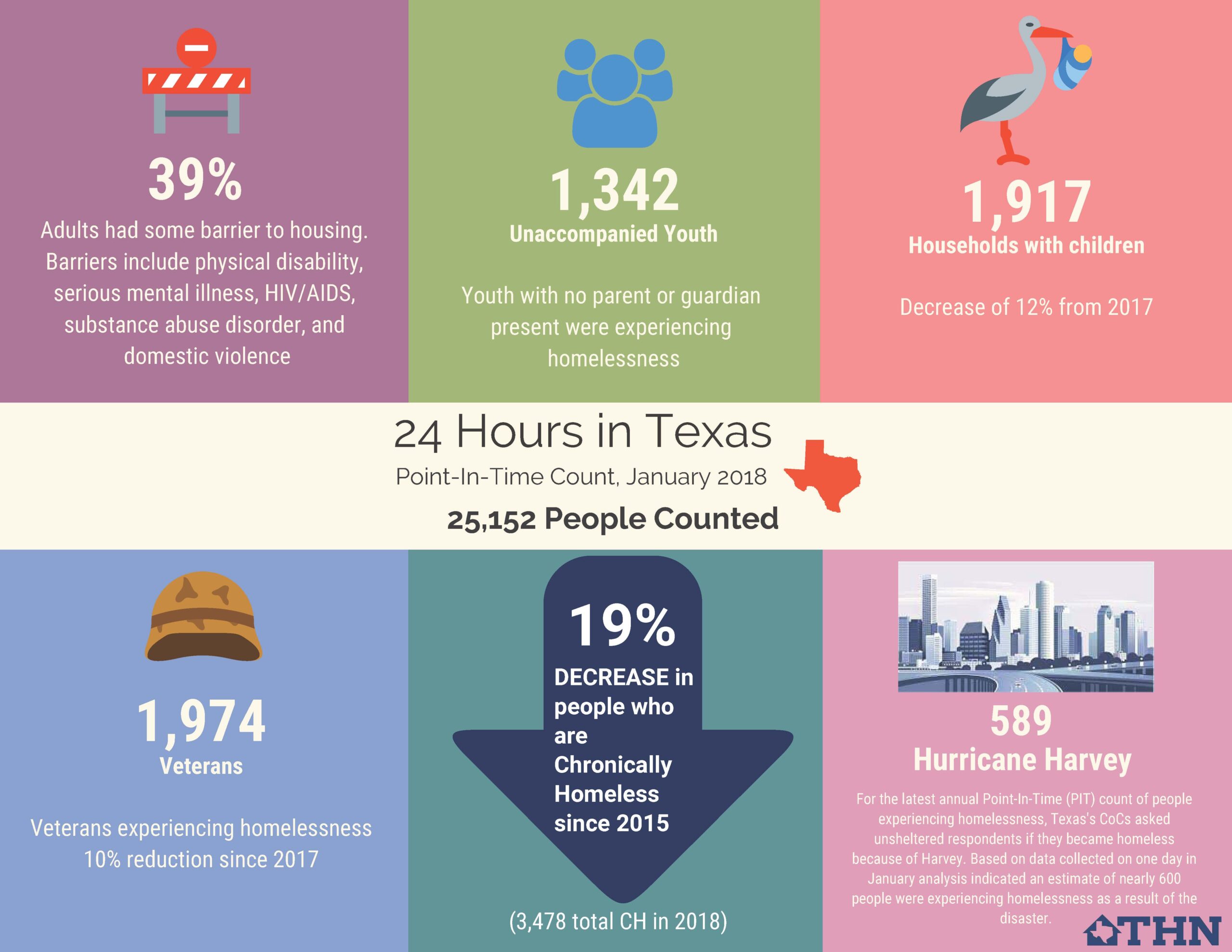
- 1,917 households with children (12% decrease since 2017)
- 1,974 veterans (10% decrease since 2017)
- 3,478 chronically homeless (19% decrease since 2015)
- 589 homeless as a result of Hurricane Harvey
Furthermore, 39% of those experiencing homelessness indicated that they had some barrier to housing (such as a physical or mental disability).
You can also track PIT homelessness trends over time by visiting the National Alliance to End Homelessness’ web page on Texas. Overall, homelessness in Texas has declined steadily across all groups studied since 2007.
TSAHC and the Fight to End Homelessness
While the 2018 PIT numbers are encouraging, the fight to end homelessness is far from over. Therefore, we continue to support and participate in the following statewide and local efforts:
- Texas Interagency Council for the Homeless (TICH): TSAHC President David Long serves as an Advisory Member of TICH, a collaborative created by state statute to coordinate the state’s resources and services to address homelessness.
- Texas Conference on Ending Homelessness: TSAHC sponsors and attends this statewide annual conference, which is put on by Texas Homeless Network. Click here to learn more and register for the next conference, which takes place in Austin on September 26-28.
- Supportive Housing Grants: TSAHC’s Texas Foundations Fund program provides matching grants to support nonprofits that provide supportive housing services to residents at risk of homelessness.
- Frequent Users Systems Engagement (FUSE) Partnership: Texas Homeless Network was recently selected to participate in FUSE, a technical assistance program offered by the Corporation for Supportive Housing to help communities and coalitions identify people most at risk of homelessness and connect them with supportive housing resources. TSAHC is participating as a partner in this initiative.
Visit www.thn.org to learn more about Texas Homeless Network and its ongoing efforts to prevent and end homelessness in Texas.
On the House blog posts are meant to provide general information on various housing-related issues, research and programs. We are not liable for any errors or inaccuracies in the information provided by blog sources. Furthermore, this blog is not legal advice and should not be used as a substitute for legal advice from a licensed professional attorney.
Related Posts


Subscribe to Our Newsletter
Sign up to have TSAHC news & updates delivered to your inbox.